Maidstone's own planners say Kent's case for quarrying Oaken Wood misapplies national policy and is unjustified, and want the site dropped. Comments close 5 October.
Maidstone Borough Council’s own planners have concluded that the plan to quarry Oaken Wood does not stand up.
Their draft response to Kent County Council, published ahead of a committee meeting on Wednesday, says the allocation of land south and west of Hermitage Quarry is “un-justified”, that the evidence behind it is “inadequate”, and that a central planning test has been “mis-applied”. It asks the examination to send the county’s evidence back for reassessment, and says the conclusion should then be that the site is not allocated.
This is a formal representation, not a veto. It goes to the independent Planning Inspector who will examine the plan.
Where it is in the process
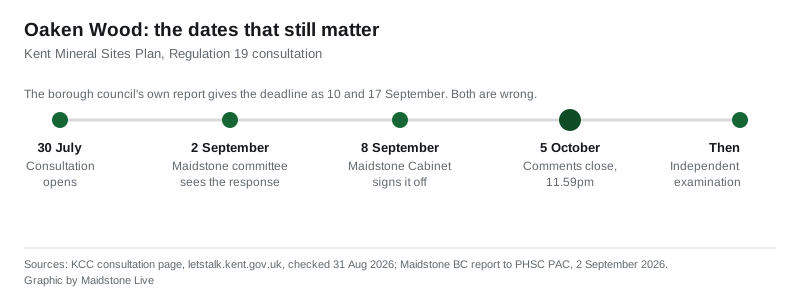
- Wednesday 2 September, Planning and Healthier Stronger Communities Policy Advisory Committee, 6.30pm at the Town Hall, considers the draft response
- Tuesday 8 September, Cabinet signs it off
- Monday 5 October, 11.59pm, the Kent County Council consultation closes
The wards named as affected are Barming Heath and Teston, and Harrietsham, Lenham and North Downs.
A warning about the dates in the council’s own report
The covering report gives the consultation deadline as 10 September in one paragraph and 17 September in two others.
Neither is right. Kent County Council has extended the consultation, and its consultation page still said, when we checked it on 31 August, that representations close at 11.59pm on Monday 5 October 2026. If you are working to the borough council’s paperwork, the real deadline is weeks later than either date it gives.
The five things the council says are wrong
The county’s justification for the allocation rests on one document, the Hermitage Quarry Suitability for Allocation Assessment Report of June 2026. Maidstone’s response takes it apart on five grounds:
- It leans on a 2013 decision made under weaker rules. The Secretary of State’s decision letter of 13 July 2013 was made under the 2012 planning framework, which protected ancient woodland less strongly. The response says the report “still relies on and draws conclusions and justifies the allocation, on the basis of that older decision”, and that “the test has been mis-applied”.
- It gives heritage stone weight that policy does not give it. The county’s report cites the framework paragraph about the conservation of historic buildings. Maidstone says that paragraph is about the impact of development on a heritage asset, not about digging up the stone used to repair one: “Quarry operations for heritage stone does not attract great weight in planning policy.”
- It treats moving the soil as if it answered the loss of the wood. The county’s assessment of ancient woodland harm focuses on soil translocation. Maidstone’s response says it “does not address or account for the total loss of the actual woodland itself”, and that the county relies on 2013 advice with no current science on whether translocation works.
- It has not tested alternatives in enough detail. The response calls the county’s alternatives analysis “somewhat outline and lacks detail”, and says it concludes little beyond that the easiest way to meet the need is at this site.
- It does not meet the “wholly exceptional” bar. Loss of irreplaceable habitat can only be permitted for wholly exceptional reasons, and the national framework’s examples are things like nationally significant infrastructure. Maidstone says a single stone quarry in Kent is not that.
There is a further argument inside that last point. Because the crushed rock and the building stone come out of the same hole, the county argues you need the aggregate to get the ragstone. Maidstone calls this “a circular argument”: “Just because you can’t get one, without the other isn’t an exceptional reason, its an operational matter, and of itself is not exceptional.”
What the council says would be lost
The response describes Oaken Wood as “a particularly locally significant landscape” and gives its reasons: its size, which has so far limited disturbance and fragmentation; a long history of rotational coppice management; its underlying geology and hydrology; and what it calls an “idiosyncratic” flora and fauna with affinities to heathland, including scarce cudweeds, green tiger beetle and nightjar.
As we reported on 26 August, the county council’s own commissioned assessment puts the loss at 42 hectares of woodland, of which 41 hectares is ancient woodland.
The downstream carbon question
One paragraph raises something the response says the minerals planning authority may wish to establish. Most of the hard rock from a Hermitage Quarry extension is destined for road building. Maidstone suggests the minerals planning authority should establish whether the Supreme Court’s Horse Hill ruling means the emissions from that end use have to be counted in the scheme’s carbon footprint, on the principle that reasonably foreseeable downstream emissions may need to be assessed.
The response is careful to add what that ruling does and does not do: an authority can still grant permission for an environmentally harmful project, provided it has properly assessed the effects and taken them into account.
And a second Maidstone site
The plan also carries forward Chapel Farm at Lenham, which was already allocated in the 2020 plan and is unchanged. Maidstone does not object to it, but says the standard 15 metre buffer to ancient woodland “may be inadequate” and asks for the plan’s wording to be amended so that a larger buffer, following Natural England standing advice, is considered.
The bigger objection about who decides
The draft plan sets out criteria that any future planning application on the site would have to satisfy, including proving that the loss of irreplaceable habitat is justified and that the national policy tests are met.
Maidstone’s response says that is the plan passing its own job to the applicant: “If for instance the planning application has to show whether the loss of irreplaceable habitat is justified, why hasn’t the Plan already confirmed this?” It calls this “kicking the decision down the road”, and argues that if the plan will not settle the question at allocation stage, the allocation itself cannot be sound.
What it means for you
You can still respond yourself, and the council’s response does not do it for you. The Inspector weighs representations from residents alongside those from councils. Comments close at 11.59pm on Monday 5 October 2026 through Kent County Council’s consultation page.
This stage is about soundness, not about whether you like it. The consultation asks whether the plan is positively prepared, justified, effective and consistent with national policy. A response that engages with those four tests, as the borough council’s does, carries further than one that does not.
Nothing is decided on Wednesday. The committee only recommends. Cabinet agrees the wording on 8 September, and the outcome for the site rests with the Inspector at examination. To speak at a meeting, contact the council on 01622 602899 or committee@maidstone.gov.uk by 4pm one clear working day beforehand.
Related: how to search, read and comment on Maidstone planning applications.
Have your say
We read every message. To comment on this story, email the newsdesk and we may publish a selection of responses: hello@maidstonelive.co.uk.