
Every Maidstone band for 2026/27, from £1,636.16 at A to £4,908.48 at H, plus what your parish adds and why 72p in the pound leaves the borough.
Council tax is one of the biggest fixed bills most households in the borough pay, and hardly anyone looks at how it is built. The Maidstone council tax bands run from A to H, the charge for 2026/27 starts at £1,636.16 and reaches £4,908.48, and the money is then divided between four separate organisations, of which the borough council keeps barely an eighth. This guide gives the figure for every band, shows exactly where it goes, explains why your parish changes the total, and covers how to check your band, challenge it and claim the discounts people most often miss. Every number comes from the council’s own published tables.
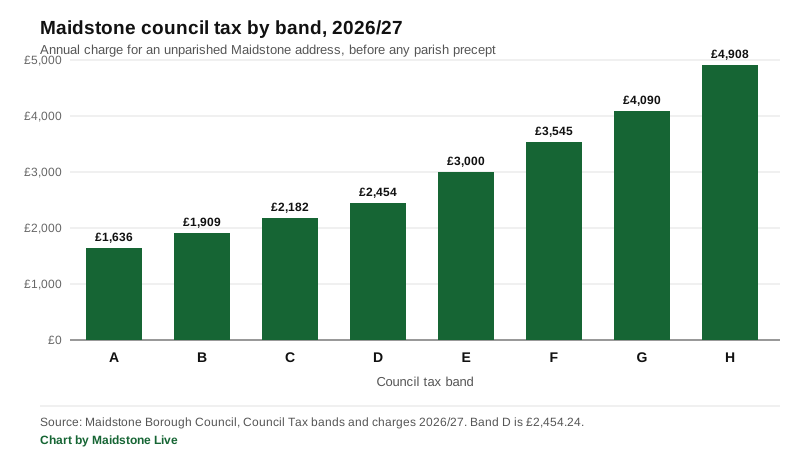
Maidstone council tax by band for 2026/27
The table below is the full charge for an address in the unparished part of the borough, which is most of Maidstone town itself, including areas such as Allington. If you live in a parish, add the precept shown further down.
| Band | 1991 property value | Annual charge | Roughly per month |
|---|---|---|---|
| A | Up to £40,000 | £1,636.16 | £164 |
| B | £40,001 to £52,000 | £1,908.85 | £191 |
| C | £52,001 to £68,000 | £2,181.55 | £218 |
| D | £68,001 to £88,000 | £2,454.24 | £245 |
| E | £88,001 to £120,000 | £2,999.63 | £300 |
| F | £120,001 to £160,000 | £3,545.01 | £355 |
| G | £160,001 to £320,000 | £4,090.40 | £409 |
| H | More than £320,000 | £4,908.48 | £491 |
Source: Maidstone Borough Council, council tax bands and charges. Monthly figures are the annual charge spread over ten instalments, which is the standard billing pattern.
What the bands actually mean
Every home in England sits in one of eight bands. The band is not based on what the property is worth now. It reflects what it would have sold for on the open market on 1 April 1991, a valuation date that has never been revisited since council tax began in 1993. That is why a modern flat and a Victorian terrace can sit closer together than you would expect, and why bands often look out of step with today’s prices.
Band D is the reference point. Every other band is a fixed proportion of it, set in law and identical everywhere in England: Band A is six ninths of Band D, Band B seven ninths, Band C eight ninths, Band E eleven ninths, Band F thirteen ninths, Band G fifteen ninths and Band H eighteen ninths, which is exactly double Band D (Maidstone Borough Council, council tax summary 2026-27). Bands are set by the Valuation Office Agency, not by the council.
Where your money actually goes
The bill arrives from Maidstone Borough Council, but the council keeps only a small slice. Four bodies each set their own charge, and three of them are nothing to do with the borough.
| Where it goes | Band D charge | Share of the bill |
|---|---|---|
| Kent County Council | £1,758.60 | 71.7% |
| Maidstone Borough Council | £310.68 | 12.7% |
| Police and Crime Commissioner for Kent | £285.15 | 11.6% |
| Kent and Medway Fire and Rescue Authority | £99.81 | 4.1% |
Source: Maidstone Borough Council, council tax summary 2026-27.
Close to 72 pence in every pound goes to Kent County Council, which pays for adult social care, children’s services, school support, libraries and most main roads. The Police and Crime Commissioner for Kent takes £285.15 at Band D and Kent and Medway Fire and Rescue the smallest slice at £99.81.
Maidstone Borough Council itself takes £310.68 at Band D, a little over an eighth of the bill, and it has raised its own share by £9 for a Band D home this year. That £310.68 is what funds bin collections, planning, parks, leisure, housing services and most of what people think of as local. The council’s net revenue budget for 2026/27 is £27.377 million, of which £21.191 million comes from council tax and £6.187 million from retained business rates. The council notes that it now receives Revenue Support Grant again following the government’s funding review, but keeps only around 8.6% of the business rates it collects, so council tax carries most of the load.
Why your parish changes the figure
The council’s precept schedule lists thirty-five parishes, each adding its own charge on top of the four above to fund very local things: recreation grounds, allotments, street furniture, community facilities. It is the only part of the bill that varies within the borough, and the spread is wider than people expect.
| Area | Parish precept at Band D | Total Band D charge |
|---|---|---|
| Maidstone (unparished) | none | £2,454.24 |
| Boughton Malherbe | £30.19 | £2,484.43 |
| Otham | £33.97 | £2,488.21 |
| Langley | £39.48 | £2,493.72 |
| Bearsted | £39.56 | £2,493.80 |
| Loose | £55.64 | £2,509.88 |
| Staplehurst | £97.41 | £2,551.65 |
| Marden | £104.39 | £2,558.63 |
| Lenham | £145.70 | £2,599.94 |
| Headcorn | £181.26 | £2,635.50 |
| Bredhurst | £218.88 | £2,673.12 |
Source: Maidstone Borough Council, council tax bands and charges and the 2026-27 council tax summary, which lists every parish.
What it means for you: the gap between the cheapest parish and the most expensive is around £189 a year at Band D, and living in the unparished town centre is cheaper still. Bredhurst pays the highest precept in the borough at £218.88, more than five times what Bearsted charges, on a parish budget of £43,563 spread across a very small number of homes. Headcorn’s £380,000 parish budget produces the second highest precept at £181.26. That said, the parish element is small next to the county and police shares, so it should never be the deciding factor in where you buy.
How to check or challenge your band
Banding is the Valuation Office Agency’s job, not the council’s, so a band challenge goes to the VOA while a billing query goes to Maidstone Borough Council.
To check your band, use the council’s own postcode search or search your postcode on the GOV.UK council tax band tool. The GOV.UK version also shows your neighbours’ bands, which is the single most useful piece of evidence you can gather: if comparable houses on your street are a band lower, you may have a case.
To challenge your band, use the free VOA challenge service on GOV.UK. You do not need to pay a company to do this. Be clear-eyed about the risk: a review can lower your band, leave it alone, or raise it. The VOA will want evidence tied to the 1991 valuation date, which in practice means the bands and historic sale prices of similar nearby homes.
Discounts, exemptions and premiums
Plenty of households pay more than they need to. The main reductions available in Maidstone are:
- Single person discount of 25%, if you are the only adult living in the property as your main home. At Band D that is worth over £600 a year.
- Students and apprentices, who are disregarded when counting the adults in a household.
- Severely mentally impaired residents, carers and disabled band reductions, where an adapted home can be charged at the band below its actual band.
- Unoccupied and uninhabitable properties, and Council Tax Support if you are on a low income (Maidstone Borough Council, discounts and exemptions).
Some homes pay nothing at all. Exemptions cover people in prison for reasons other than council tax arrears, those living in hostels, long term hospital patients, members and dependants of visiting forces, members of religious communities, and partners and dependants of foreign students.
The charges run the other way too, and steeply. Second homes carry a 100% premium from 1 April 2025, meaning a furnished property that is not your main residence is billed at 200% of the normal charge. That covers holiday homes, properties between lets and homes let out on sites such as Airbnb. Long term empty homes are worse: from 1 April 2025 the clock starts at 12 months rather than two years, and the premium is 100% after a year, 200% after five years and 300% after ten. Statutory exceptions exist, including homes actively marketed for sale or letting for up to 12 months, annexes, job-related dwellings and properties undergoing major structural repair (Maidstone Borough Council, long-term empty and second homes).
Frequently asked questions
How much is council tax in Maidstone per band for 2026/27?
For an unparished Maidstone address: Band A £1,636.16, Band B £1,908.85, Band C £2,181.55, Band D £2,454.24, Band E £2,999.63, Band F £3,545.01, Band G £4,090.40 and Band H £4,908.48. Parish areas add a precept on top.
What is the Band D council tax in Maidstone?
£2,454.24 for 2026/27 in the unparished part of the borough. With a parish precept it ranges from £2,484.43 in Boughton Malherbe to £2,673.12 in Bredhurst.
Where does my Maidstone council tax go?
At Band D, £1,758.60 goes to Kent County Council, £310.68 to Maidstone Borough Council, £285.15 to the Police and Crime Commissioner for Kent and £99.81 to Kent and Medway Fire and Rescue. The borough council keeps about 13 pence in the pound.
How do I check what council tax band my house is in?
Use the council’s postcode search or the GOV.UK band checker, which also shows neighbouring properties. Your bill states your band too.
Can I challenge my Maidstone council tax band?
Yes, free of charge, through the VOA challenge service. The Valuation Office Agency sets bands, not the council. Gather evidence from similar nearby homes first, because a review can raise your band as well as lower it.
Does Maidstone charge extra on second homes?
Yes. Since 1 April 2025 a furnished property that is not someone’s main residence attracts a 100% premium, so the total charge is 200% of the standard bill. Long term empty homes attract 100% after a year, rising to 300% after ten years.
Sources
- Maidstone Borough Council, council tax bands and charges, for the band A to H figures, the 1991 value ranges and the full parish table
- Maidstone Borough Council, council tax summary 2026-27, for the precepting breakdown, the £27.377m revenue budget, the £9 Band D increase and the parish precepts
- Maidstone Borough Council, discounts and exemptions
- Maidstone Borough Council, long-term empty and second homes
- Valuation Office Agency, and GOV.UK’s check your band and challenge your band services
Figures are those published by Maidstone Borough Council for 2026/27 and were checked in August 2026. Charges are reset each spring. For the other bills and services that come with a Maidstone address, see our guides to parking in Maidstone and bin collection days.
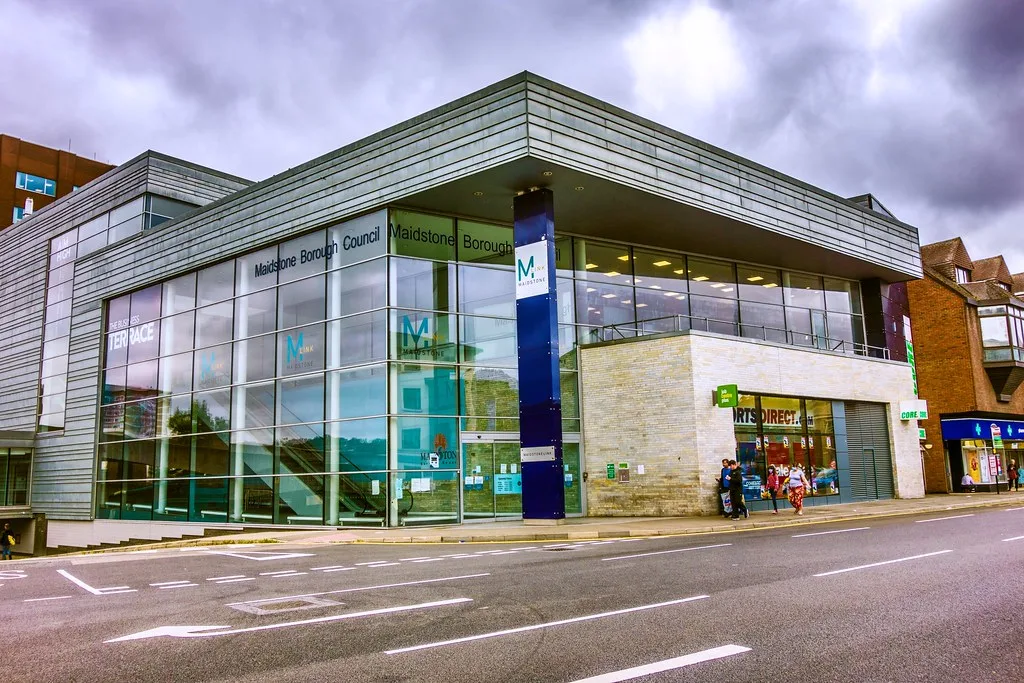
Image: Maidstone Borough Council’s offices, which set and collect the bill described above. “Maidstone Borough Council Offices” by John K Thorne, CC BY 2.0, via Flickr (https://www.flickr.com/photos/89918055@N05/50270943548).
Have your say