
37 residents, chosen from 109 applicants, wrote eight recommendations on violence against women and girls. Cabinet backed the resulting plan on 22 July with £250,000.
Free youth clubs, safer public spaces and more women in local politics are among eight things a panel of 37 Maidstone residents has asked the borough to act on, and the council has put £250,000 behind the plan that came out of it.
Cabinet approved the action plan on 22 July. The council published the findings on 19 August. It says the exercise is believed to be the first of its kind in England on violence against women and girls.
How the panel was put together
The work traces back to a Full Council motion passed in December 2024. Following a competitive tender, the council commissioned Involve UK to run it.
The Cabinet report sets out the mechanics:
- recruitment ran from November 2025 to January 2026
- 109 people applied and 37 were selected, chosen to reflect the borough across five criteria: age, gender, ethnicity, social and economic background, and urban or rural balance
- the panel met across four sessions between February and March 2026
- two borough-wide surveys, one for adults and one for young people, drew over 1,250 responses before the sessions began
- 14 expert speakers and a network of more than 60 voluntary and community sector organisations took part
Involve recommended dropping the citizens’ assembly model the council originally tendered for. It used “enclave deliberation” instead, where people first talk in groups that share an identity before coming together. The four groups were women aged 18 and over, young women aged 16 to 18, men aged 18 and over, and young men aged 16 to 18.
The eight recommendations, in the panel’s priority order
The report reproduces them in the participants’ own words. Summarised:
- Lifelong learning. Education about violence against women and girls should run through schools, workplaces, community spaces and adulthood, not stop at school.
- Government action. The council should lobby for a dedicated coordinator in every parish, district and eventually county council.
- Women’s representation. Proportional representation of women and gender minoritised people in decision-making roles.
- Support for survivors. A single trusted support system, which the panel named STAR, for safe disclosure, immediate help and long-term care.
- Breaking cycles of abuse. Invest in families to stop abuse continuing.
- Public spaces. Community input, awareness campaigns and better visible security so people feel safe outdoors.
- Difficult conversations. Actively encourage community discussion, because without it public awareness fades.
- Shared social spaces. Bring back free youth clubs, run as a charity with local government funding.
The recommendations went to the Safer Maidstone Partnership’s VAWG Action Group at a workshop in May, and the action plan was finalised on 4 June. Three changes were made in translation: the reference to poverty was reframed to avoid implying abuse is uniquely a poverty problem, the experiences of 18 to 30s and older women were added as a gap, and extra actions on feelings of safety were included.
The money
There is no existing budget for this work at the council. The report is direct about that, and about the scale of what is needed.
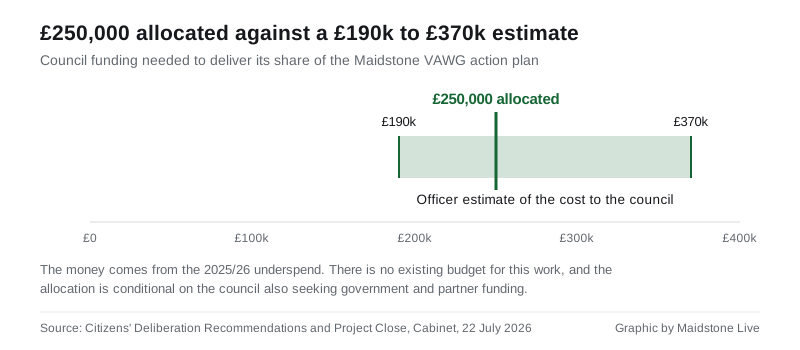
Officers estimated the council would need between £190,000 and £370,000 to deliver its share. Cabinet identified £250,000 from the 2025/26 underspend, on condition that the council also pursues government funding streams and investment from local partners.
Much of the plan is meant to be delivered from existing staff time. The report says service areas including Policy, Community Safety and Communications will in some cases have to be directed to reprioritise. The council also proposes creating a coordinator or programme manager post, with explicit responsibility for chasing external funding so the work does not rest on the council’s budget alone.
What the council has actually signed up to
Appendix 3 of the report lists the actions assigned to the council alone. They include:
- achieving White Ribbon accreditation, and helping other organisations achieve it
- mapping current support provision across the borough, including where the gaps are
- a borough-wide campaign on where safe spaces are and when they are available
- engaging women and girls on their experience of public spaces, and feeding that into planning decisions
- an “Access to Politics” campaign, seeking support from local parties and parish councils
Councillors were also asked to make a cross-party commitment to improving women’s participation in local democracy, including speaking out against abuse aimed at councillors and candidates. Cabinet endorsed that.
Councillor David Naghi, Cabinet Member for Community Cohesion and Safety, said in the council’s statement: “What makes this work so powerful is that these ideas have come directly from Maidstone residents. They are practical, ambitious and rooted in real experiences of life in our borough.”
What it means for you
Nothing in the plan changes a service you use this week. What it does is commit the council to a set of dated actions and a named budget, both of which can be checked later.
Two things are worth watching. The first is whether the coordinator post is actually created, because the report treats it as the mechanism for everything else. The second is whether the £250,000 stretches, given officers put the likely cost as high as £370,000 and the council’s own condition is that partners and government make up the difference.
Delivery sits with the Safer Maidstone Partnership’s VAWG Action Group, which brings together community safety, health, housing and education bodies. The full action plan and the list of council-assigned actions are published as appendices to the Cabinet decision.
Have your say