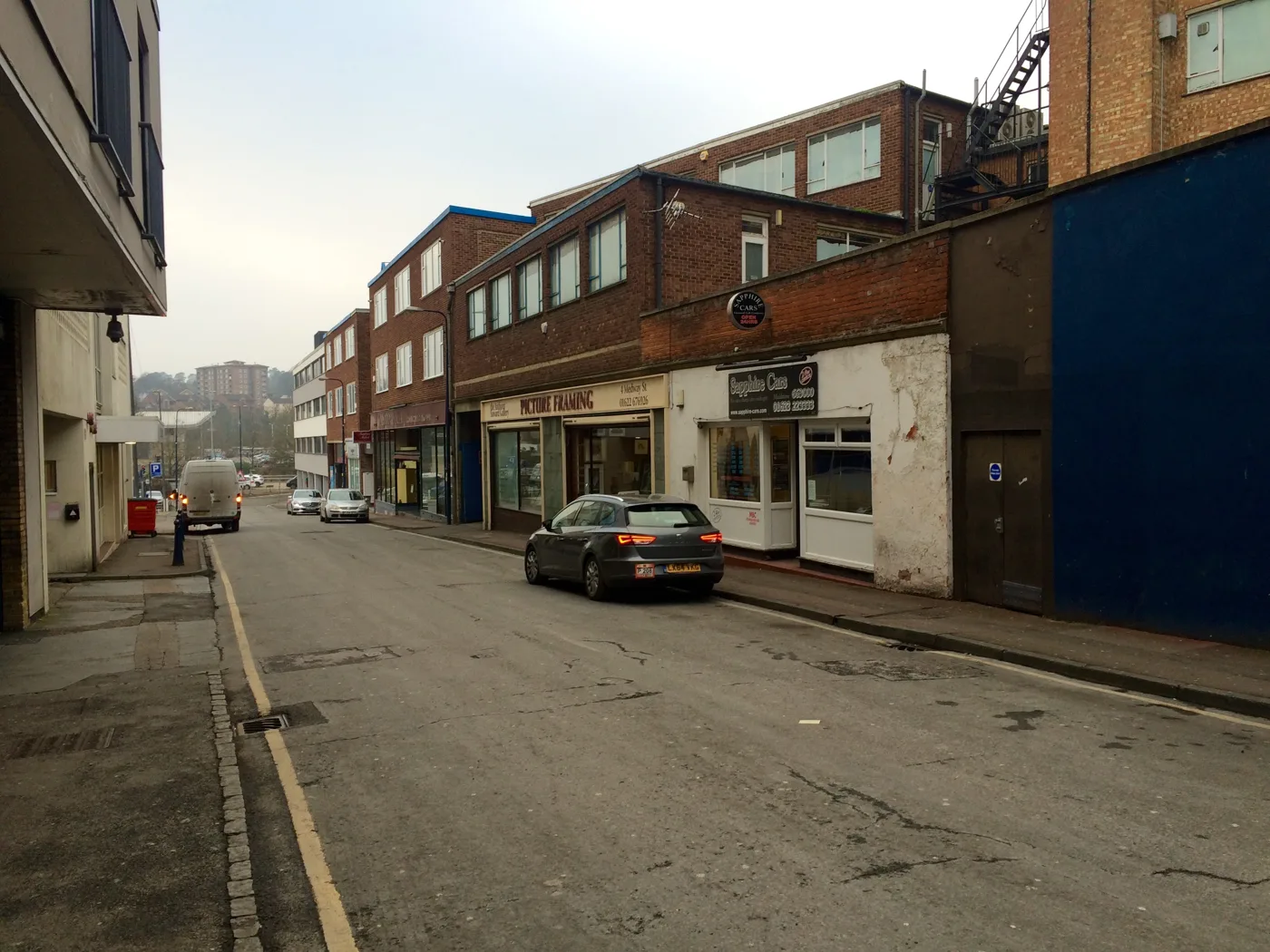

Invicta House and four other town centre blocks would lose the right to become flats without a planning application. Cabinet agreed to proceed on 22 July.
Five office properties in Maidstone town centre are to be stripped of the right to be turned into flats without a planning application.
Maidstone Borough Council’s Cabinet agreed on 22 July to proceed with an Article 4 direction covering office buildings of more than 1,500 square metres inside the town centre boundary. The decision took effect on 1 August. The council announced it publicly on 19 August.
An Article 4 direction does not ban anything. It removes a permitted development right, so that a change of use needs a planning application and can be judged against the Local Plan. Anyone who wants to convert one of these buildings would still be able to apply.
The five properties, and how big they are
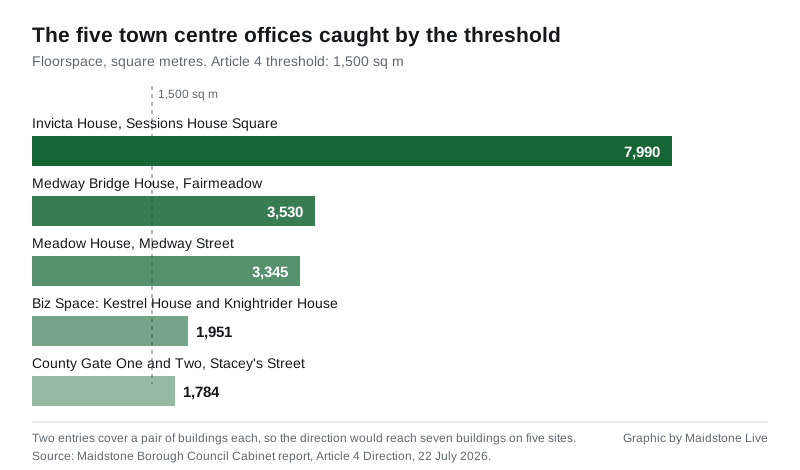
The officer report lists the properties that meet the 1,500 square metre threshold:
- Invicta House, Sessions House Square, 7,990 sq m
- Medway Bridge House, Fairmeadow, 3,530 sq m
- Meadow House, Medway Street, 3,345 sq m
- Biz Space, Kestrel House and Knightrider House, 1,951 sq m
- County Gate One and Two, Stacey’s Street, 1,784 sq m
Two of those entries cover a pair of buildings each, so the direction would reach seven buildings on five sites.
Invicta House is by far the largest. It is owned by Kent County Council and is currently in use as offices.
Why large offices can convert without permission
The right in question is Class MA, which allows buildings in commercial Use Class E to become homes in Use Class C3 through a prior approval process rather than a full planning application.
Until 2024 that right was capped. The Town and Country Planning (General Permitted Development) (England) (Amendment) Order 2024 removed the 1,500 square metre floorspace limit and the requirement that a building had been vacant for three months. Those changes came into force on 5 March 2024.
That is the gap the council is trying to close. Before March 2024 a building the size of Invicta House could not have used the right at all.
What the evidence says about the town centre
Officers commissioned Rumfitt Associates to build an evidence base, because national policy sets a high bar for Article 4 directions on residential conversions. The report’s findings, as summarised in the Cabinet paper, include:
- In the town centre area (Maidstone 004H) only 13.3% of homes are owner-occupied and 65.7% are privately rented, the highest rate locally in 2025.
- 96.7% of dwellings are flats. 54.9% have two rooms or fewer, 59.3% have no private outdoor space and 2.6% have no central heating.
- Both room-based and bedroom-based overcrowding run significantly higher than anywhere else in the borough.
- Of housing condition complaints recorded in converted properties, 41% relate to damp, 14% to disrepair and 12% to fire.
- The town centre’s overall deprivation rank fell by more than 25% between 2015 and 2025, from the 29th to the 21st percentile nationally.
- On the child poverty measure, the share of children in income-deprived households rose from 18% in 2019 to 62% in 2025, placing the town centre in the most deprived 0.26% of neighbourhoods in England.
- Community safety complaints linked to converted blocks grew from 11 between 2014 and 2020 to 27 between 2021 and 2026.
The report states that the town centre is now in the worst 10% of areas in England for crime. It also sets out the council’s position in its own words: “The Council’s concern is not who lives in the Town Centre. It is the quality of the homes that are being delivered, the absence of supporting infrastructure and the cumulative impact on the quality of place.”
The paper points at one incident in particular. A flood at Miller Heights on 11 May 2026 damaged the building’s electricity supply. According to the report it:
- required a prohibition notice
- forced residents into temporary accommodation, at a cost to the council
- drew in Kent Fire and Rescue, the housing ministry and the Building Safety Regulator
The numbers behind the threshold
The report is blunt about the scale. Quoting the evidence base: “Without a Direction, the next potential tranche of 505 units will arrive on the same terms as the last 999: outside the planning system, outside the Local Plan and outside the standards the Council has set for the Town Centre.”
The 1,500 square metre cut-off is a deliberate compromise. Officers calculate that a building of that size yields roughly 20 flats once communal space is deducted. Setting the bar there captures about 58% of the potential conversion pipeline, 405 dwellings of 693, and leaves small shop and office conversions alone.
Where it came from
This started as a fight about one building. Councillor Russell, seconded by Councillor Parfitt, put a motion to full Council on 3 December 2025 seeking an immediate Article 4 direction on Invicta House. The motion argued that a permitted development conversion would collect no CIL or section 106 money for schools or roads.
Council sent the matter to committee. Cabinet asked officers in March 2026 to work up a direction covering the wider category of large town centre offices rather than one address. The Planning and Healthier Stronger Communities Policy Advisory Committee backed the result on 7 July, and Cabinet approved it on 22 July.
Councillor Tony Harwood, Cabinet member for planning policy and management, said in the council’s announcement that “it is vital that the county town of Kent retains its administrative, business and commercial heart”.
What happens next, and how long it takes
Nothing has changed yet. The council’s list of Article 4 directions, checked on 24 August, does not include the town centre offices. The council says it is now beginning the statutory process.
The steps set out in the report are:
- The direction is drafted, with a plan identifying the buildings.
- It is made, then publicised by newspaper notice, site notices and service on owners and occupiers. A copy goes to the Secretary of State.
- Representations are invited for at least six weeks.
- Those representations return to Cabinet, via the policy advisory committee, before the direction is confirmed.
- If confirmed, a non-immediate direction takes effect a year after it was made.
There is no right of appeal against an Article 4 direction. It can be challenged by judicial review, and the Secretary of State can modify or cancel it at any point, before or after confirmation.
That timetable matters. A direction made this autumn would not bite until late 2027 at the earliest. Maidstone Borough Council is due to be abolished in April 2028, so the successor authority is likely to be the one enforcing it.
What it means for you
If you live in the town centre, this is the council conceding that a large share of the housing built around you over the past decade was never assessed against its own standards. The direction does not fix existing flats. Housing condition complaints go to the council’s housing team, and the evidence base shows damp is the single biggest category.
If you live near one of the five sites, the practical change is that you would get to comment. A prior approval application under Class MA is a narrow technical check. A full planning application is publicised, is open to objections and can carry conditions and contributions.
If you want to have your say on the direction, watch for the public notice. Once the direction is made there will be a minimum six-week window for representations, and the council has said it will publish it on its website as well as in a newspaper notice and on site.
If you want to follow what is being applied for now, applications in the borough are searchable on the Mid Kent planning portal. Our guide to Maidstone planning applications explains how to comment, and our planning news page tracks the borough’s housing target and the schemes in the pipeline.
Sources: Maidstone Borough Council Cabinet decision, 22 July 2026; officer report and Appendix 1, the evidence base; Cabinet decision on Invicta House, March 2026; SI 2024/141. Checked 24 August 2026.
Have your say